
How To Create A Healthy Living Space
THE BALANCE BETWEEN COMFORT & HEALTH
Creating A Healthy Living Space
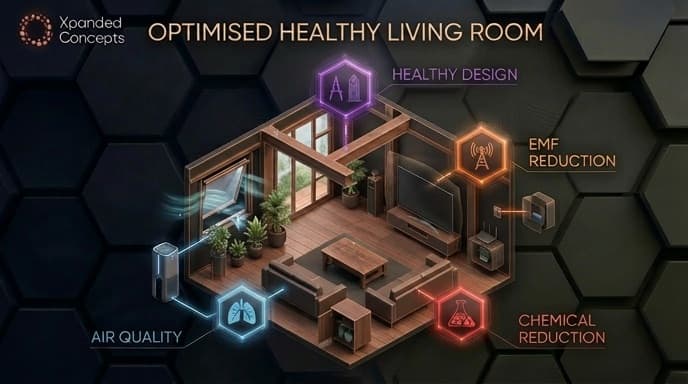
We put a lot of thought into how our living spaces look and feel, the furniture, the colours, the layout. Building biology asks us to add one more layer to that thinking: how is this space affecting the health of the people in it? Given that the living room is where most families spend the majority of their time at home, it is a question worth asking carefully.
How much weight you place on creating a healthy living space comes down to one thing - time.
For someone who arrives home late and spends an hour unwinding in front of the television before bed, the living room is a relatively low-exposure environment. But for a family with young children at home during the day, someone who works from the couch, or a person who spends the majority of their evening hours in the living space, the calculation changes significantly. The more hours you spend in a space, the greater its influence on your overall health and the more attention it deserves.
Time is the multiplier - and it is the first question worth asking before making any decisions about how to improve the space.


Living Space Building Design
The healthiest living spaces are not created by what you put inside them, they begin with how the building itself is designed and oriented. From a building biology perspective, getting the fundamentals of building design right means working with the natural environment rather than against it, reducing the need for mechanical heating, cooling and ventilation by letting the sun and wind do the work passively.
SOLAR ORIENTATION
In the Southern Hemisphere, the sun tracks across the northern sky. A living space with its primary glazing facing north receives sun throughout the day, warming the space naturally in winter when the sun is lower on the horizon, while a correctly designed eave or overhang shades the same glass in summer when the sun is higher. This is the foundation of passive solar design and it costs nothing to run.
Read moreShow less
East-facing living spaces receive morning sun, pleasant and gentle, but limited in its ability to warm a space through the day. West-facing is the most problematic orientation for a living space, afternoon sun in summer is low, intense and difficult to shade, driving heat loads that make a room uncomfortable and push occupants toward air conditioning. South-facing living spaces receive little to no direct sun in winter, making them inherently cooler and more reliant on artificial heating.
North is the preferred orientation for a living space in Australia, it is the orientation that gives you the most control over your internal environment across all seasons.
PREVAILING WIND AND NATURAL VENTILATION
Understanding the prevailing wind direction for your location and how it shifts across the seasons is fundamental to designing a living space that breathes naturally. Most locations have a dominant wind pattern that holds for much of the year, with seasonal shifts that a well-designed home can be oriented to capture.
Read moreShow less
The living room is the natural ally in this strategy. It typically contains the largest doors and openings in the home, sliding or stacking doors, large windows, operable louvres and these, when oriented and designed thoughtfully, become powerful tools for capturing natural airflow. A living space that opens broadly to the prevailing breeze and has a corresponding opening on the leeward side creates cross ventilation that can make mechanical cooling unnecessary for a significant part of the year.
The goal from a building biology perspective is to maximise the number of days per year the home can be naturally ventilated rather than sealed and mechanically conditioned.
Mould In The Living Space
The living room does not typically have a concentrated moisture source, making it generally the lowest mould-risk room in the home. That said, it is not immune, and there are several sources worth understanding.
Read moreShow less
In modern homes with open plan layouts, the kitchen and living space often share the same air volume. This changes the moisture equation considerably. Cooking produces significant steam and humidity, and if the range hood is not properly ducted to the outside, or is simply recirculating air back into the room that moisture has nowhere to go but into the shared living space. A recirculating range hood is one of the most common and least recognised sources of elevated humidity in open plan living areas, and over time in a poorly ventilated home, it contributes meaningfully to mould risk.

Beyond the kitchen, common mould sources in a living space include external spores entering through large openings and doors, split system or ducted AC units that harbour mould on internal coils and distribute spores every time they run, penetrating damp from leaking roofs or blocked gutters, and stagnant air pockets behind furniture pushed against external walls.
Read moreShow less
The strategies are straightforward, ensure the range hood is externally ducted rather than recirculating, keep AC units regularly cleaned and serviced, ventilate the living space daily, and address any water ingress promptly. The living room is not a high-risk environment when a home is well maintained, but these few consistent habits keep it that way year round.


Living Room Air Quality
Of all the rooms in the home, the living space presents the most varied and complex mix of air quality challenges. It is where we cook, heat, clean, keep pets and spend our leisure hours, and each of these activities brings its own contribution to the air we breathe.
COMBUSTION APPLIANCES
Wood heaters and open fireplaces are a significant source of fine particulate matter, carbon monoxide and a range of combustion byproducts. Gas heaters present a less visible but equally relevant concern. Unflued gas heaters, those without a flue to the outside release combustion byproducts including nitrogen dioxide directly into the living space. Nitrogen dioxide is a respiratory irritant and at sustained levels a genuine health concern, particularly for children and those with asthma. From a building biology perspective, unflued gas heaters in living spaces are one of the more significant and underappreciated air quality risks in Australian homes.
Read moreShow less
Scented Candles & incense, while seemingly minor, are a combustion source that produces fine particulates and VOCs, particularly paraffin-based candles, which are derived from petroleum. Essential oil diffusers are another commonly overlooked source. Ultrasonic diffusers add moisture to the air continuously. The oils themselves, while natural in origin, are chemically complex and release VOCs into the air.
Open Plan Kitchens and Cooking Emissions - In open plan living spaces, cooking is an air quality event for the entire room. Gas cooktops produce nitrogen dioxide and carbon monoxide during normal operation. All cooking, regardless of fuel source produces fine particulate matter, moisture and VOCs from heating oils and food. Without adequate extraction, these disperse freely through the shared living space.
Synthetic Furnishings and Off-Gassing - The living room is typically the most furnished room in the home. Sofas, rugs, carpet, curtains, entertainment units and shelving all contribute to the VOC load of the space
Dust, Allergens and Pet Dander - The living room accumulates dust at a rate that rivals the bedroom. Carpet, soft furnishings, cushions and clutter create a significant reservoir for dust mite allergens, pet dander, tracked-in pollutants and particulate matter. Pets spend the majority of their indoor time in the living space, making dander concentration here higher than anywhere else in the home. For allergy and asthma sufferers, the living room floor and soft furnishings are often the primary exposure environment.
Living Room Ventilation
The living room represents the greatest opportunity for natural ventilation in the home. No other room typically has the same volume of operable openings, sliding doors, stacking doors, large windows, louvres, and this gives the living space a natural advantage for flushing and refreshing indoor air.
Read moreShow less
This is where building design and daily habits intersect. A living room that has been designed with its primary openings oriented to the prevailing breeze, and corresponding openings on the opposite side of the space, can achieve genuine cross ventilation with nothing more than open doors and windows.
The key is using what you have deliberately. Large doors that remain closed because of habit, noise or air conditioning dependence represent a missed opportunity. Even in homes not optimally oriented, opening the living space broadly for periods throughout the day, particularly in the morning before heat builds, and in the evening when outdoor air cools, creates meaningful air changes that dilute CO₂, VOCs, cooking emissions, moisture and biological contaminants accumulated during the day.
NATURAL VENTILATION - SINGLE-SIDED VS CROSS VENTILATION
How air moves through a bedroom determines how effectively these contaminants are diluted and removed.
Read moreShow less
Single-sided ventilation is one window or opening on one side of the room. Air exchange happens, but it is driven only by wind pressure and temperature difference. It is limited in depth, meaning air in the centre and far side of the room may barely turn over. On still nights it can be almost ineffective.
Cross ventilation occurs when openings exist on opposite or adjacent sides of a room, a window and a door, or windows on two walls. Air flows through the space rather than just in and out of the same opening. This dramatically increases the volume of air exchanged, reduces CO₂ buildup, carries moisture and contaminants out of the room far more effectively, and does so passively without mechanical assistance.
From a building biology perspective, cross ventilation is the gold standard for natural ventilation. Where it isn't possible through layout, mechanical ventilation becomes an important consideration.
Mechanical Ventilation
WHOLE-HOUSE FAN/VENTILATION
A whole-house fan is a powerful central exhaust fan, typically installed in a ceiling or stairwell that exhausts a large volume of air from the home, drawing fresh air in through whichever windows and doors are open. By controlling which openings are open you can direct airflow through the house, creating a genuine whole-home breeze. It is a low-cost, low-tech and highly effective solution for whole home ventilation & comfort.
HEAT RECOVERY VENTILATION (HRV)
An HRV continuously replaces stale indoor air with fresh outdoor air, passing both streams through a heat exchanger that transfers warmth from the outgoing air to the incoming air. The result is continuous fresh air without the heat loss of simply opening a window. HRVs are best suited to cold climates where heating costs are significant and windows are kept closed for extended periods.
ENERGY RECOVERY VENTILATION (ERV)
An ERV works on the same principle as an HRV but also transfers moisture between the air streams, moderating humidity in both directions, reducing incoming humidity in wet seasons and retaining indoor humidity in dry, cold conditions. This makes it a more balanced year-round performer across a wider range of climates.
Strategies for Improving Air Quality in the Living Space
Manage what comes through the door
Remove shoes at the entry and keep outdoor footwear out of the living space. Every pair of shoes tracks in pesticides, road chemicals, heavy metals, bacteria and particulate matter that deposits into flooring and re-enters the air with every footstep. A washable entry mat adds another layer of capture before contaminants reach the living space.
Vacuum regularly with the right equipment
Use a vacuum fitted with a HEPA filter and a motorised brush head. Standard vacuums without HEPA filtration redistribute fine particles, allergens and spores back into the air while collecting larger debris. Vacuum not just floors but sofas, cushions, rugs and curtains - soft furnishings accumulate allergens at a rate comparable to carpet.
Ventilate deliberately and daily
Open the living space broadly every day to flush accumulated CO₂, VOCs, cooking emissions and biological contaminants. Morning and evening are the best windows - before heat builds and after outdoor temperatures drop. Even twenty to thirty minutes of through-flow makes a measurable difference.
Duct the range hood to the outside
In open plan living spaces, cooking is an air quality event for the entire room. A properly externally ducted range hood removes cooking particulates, nitrogen dioxide, moisture and VOCs at the source before they disperse through the living space.
Replace or avoid unflued gas heaters
Unflued gas heaters release nitrogen dioxide and other combustion byproducts directly into the living space. From a building biology perspective they are one of the most significant and underappreciated air quality risks in Australian homes.
Operate wood heaters correctly
Use only dry seasoned timber, ensure the heater is well sealed and regularly maintained, and keep a window slightly open when the heater is running to ensure adequate combustion air and reduce spillage of combustion byproducts into the room.
Be mindful of candles, incense and essential oil diffusers
All three contribute to the chemical and particulate load of the living space. Use them sparingly, choose natural beeswax or soy candles over paraffin, and always ventilate when they are in use. Essential oil diffusers also add moisture to the air - factor this in during humid periods.
Choose low-VOC materials and furnishings
When replacing flooring, furniture or soft furnishings, select low-VOC certified products. Allow new items to off-gas in a well ventilated space before bringing them into the home. Natural materials - solid timber, wool, cotton, natural latex - are preferable to synthetic and composite alternatives.
Choose hard flooring where possible
Hard flooring with washable rugs dramatically reduces the dust, allergen and dander reservoir compared to wall-to-wall carpet and is significantly easier to keep clean.
Keep pets groomed and bedding clean
Pet dander is one of the most concentrated allergen sources in a living space. Regular grooming reduces airborne dander load, and washing pet bedding frequently prevents it becoming a reservoir of biological contamination.
Keep AC units clean
Split system filters should be cleaned monthly. Units should be professionally serviced at least annually to clean internal coils where mould and bacteria establish. A dirty AC unit distributes biological contaminants directly into the living space every time it runs.
Reduce clutter
Clutter accumulates dust and reduces the effectiveness of cleaning. Simpler, less cluttered living spaces are easier to keep clean and maintain lower particulate and allergen loads.
Use a combined HEPA and activated carbon air purifier
Size the unit appropriately for the room volume and run it consistently. The HEPA layer captures biological particles - dust, dander, spores and fine particulates. The activated carbon layer adsorbs VOCs, cooking emissions and gaseous pollutants. In a room with this many potential air quality sources, a quality air purifier is one of the most practical and effective investments available.
Not All Air Purifiers Are Equal - See Why Xpanded Concepts Chooses Innova Air

EMF in the Living Room
The single most important variable in EMF exposure is time. The bedroom demands attention because we spend seven to nine hours there unconscious and unable to make active choices. The living room demands attention for a different reason - it is where we spend the majority of our conscious hours at home, often for three to five hours every evening, day after day, year after year. That cumulative exposure adds up in a way that is easy to underestimate.
SOURCES OF EMF IN THE LIVING SPACE
Wi-Fi routers
The router is one of the highest output RF sources in the home and is frequently positioned in or adjacent to the living space for signal coverage. It broadcasts continuously, twenty four hours a day, regardless of whether any device is actively using it.
Television and entertainment systems
Modern televisions are wireless devices - they connect to Wi-Fi, Bluetooth and in some cases emit RF continuously even in standby mode. Soundbars, streaming devices, gaming consoles and set top boxes add to the RF environment of the entertainment area, which is often where people sit for extended periods.
Smart devices and home automation
Smart speakers, smart lighting hubs, voice assistants and home automation controllers are RF-emitting devices that operate continuously. The living room tends to accumulate these devices over time, often without much thought given to the cumulative RF environment they create.
Cordless phones
DECT cordless phone base stations emit RF continuously regardless of whether a call is being made. They are frequently placed in living spaces and represent a significant and often overlooked source of continuous RF exposure.
AC magnetic fields from wiring and appliances
High-draw appliances - large televisions, gaming systems, powered subwoofers - generate AC magnetic fields in their immediate vicinity. The position of the main switchboard or meter box relative to the living space wall is also worth considering, as magnetic fields pass through building materials unimpeded.
Smart meters
Many Australian homes now have smart meters installed on the external wall of the home. Depending on their location, they can be a source of RF exposure directly into an adjacent living space.
MITIGATION STRATEGIES
Position seating away from high-output RF sources
Distance is the most effective mitigation for RF fields - exposure drops off rapidly as you move away from the source. Assess where people sit most consistently in the living space and ensure the router, smart meter and primary RF-emitting devices are not immediately adjacent to those positions.
Turn Wi-Fi off when not in use
A router on a smart plug or timer can be set to switch off automatically during hours the household is not actively using the internet - reducing continuous background RF exposure without any lifestyle impact.
Use ethernet where possible
Connecting televisions, streaming devices and gaming consoles to the internet via a wired ethernet connection rather than Wi-Fi eliminates the device's need to communicate wirelessly, reducing the RF environment of the entertainment area meaningfully.
Switch devices off at the wall rather than leaving on standby
Standby mode on televisions and entertainment devices maintains wireless connectivity and continues to emit RF. Switching off at the wall eliminates this entirely and has the added benefit of eliminating any light emitted by standby indicators.
Replace cordless phones with corded alternatives
A corded landline in the living space eliminates the continuous RF output of a DECT base station entirely.
Be deliberate about smart device placement
Smart speakers and voice assistants placed directly beside a sofa or armchair where someone sits for hours each evening represent an unnecessary and easily avoided source of close-proximity RF exposure. Relocating them to a less occupied part of the room costs nothing.

KNOW YOUR ENVIRONMENT - THE VALUE OF EMF TESTING
Awareness is the foundation of any mitigation strategy, but awareness without measurement is guesswork. EMF fields are invisible and our senses give us no indication of their presence or intensity, which means two living spaces that look identical can have very different EMF environments depending on wiring, appliance placement, neighbouring properties and proximity to infrastructure. EMF testing takes the guesswork out of the equation entirely. It identifies the actual sources and levels present in your specific living space, allows mitigation efforts to be targeted where they matter most, and gives you a measurable baseline to work from. For anyone spending significant hours in a space, particularly families with young children understanding your actual exposure rather than assuming it is one of the most valuable steps you can take.

Chemicals In The Living Space
The living room is not typically considered a high chemical risk environment. But it is the largest room in most homes, often the most furnished, and the space where the greatest variety of materials, finishes and products converge. The cumulative chemical load is worth understanding.
Flooring and Floor Coverings
The floor is the largest surface area in the living space and one of the most significant sources of VOC off-gassing. Synthetic carpet off-gasses from both the fibre itself and the adhesives and backing materials used in its construction. Vinyl and laminate flooring, increasingly popular in Australian homes, can be significant sources of VOCs including formaldehyde, particularly in lower-cost products. Even the adhesives used to install hard flooring can continue to off-gas through the surface for months after installation. Natural alternatives, solid timber, wool carpet, stone and tile, carry a significantly lower chemical load and are worth prioritising when flooring choices are being made.
Furniture and Soft Furnishings
The sofa is often the single largest source of chemical off-gassing in a living space. Conventional sofas combine polyurethane foam, a petroleum-derived product that off-gasses VOCs including toluene and benzene, with MDF or particleboard frames that emit formaldehyde, fabric treatments for stain and water resistance, and flame retardant chemicals applied to the foam and fabric. New sofas and lounge furniture represent the highest risk period, with off-gassing rates elevated significantly in the first months after purchase.
Painted Surfaces and Finishes
Walls, skirting boards, shelving and timber finishes continue to off-gas VOCs long after they appear and smell dry. In a living room that has been recently painted or renovated, the surface area of treated walls represents a meaningful ongoing source of chemical load, particularly in a room that is kept closed and poorly ventilated. Low-VOC and zero-VOC paints are widely available and represent a straightforward substitution with meaningful air quality benefits.
Cleaning Products
The products used to clean living room floors, surfaces and soft furnishings leave chemical residues that off-gas and accumulate in household dust. Fragranced spray cleaners, furniture polishes and fabric fresheners are among the highest VOC sources in this category, the fragrance itself is typically a complex mixture of synthetic chemicals. Switching to fragrance-free, low-tox cleaning alternatives reduces the ongoing chemical contribution of cleaning to the living space air significantly.
Plastics and Electronics
The entertainment area of a living room concentrates a significant volume of plastic, television casings, remote controls, cables, gaming consoles and streaming devices. Plastics off-gas a range of chemicals including flame retardants and plasticisers, and do so at an accelerated rate when warm. A television or gaming console that runs hot for several hours every evening is a continuous chemical source in the room. Ensuring adequate ventilation around electronic equipment and not enclosing it in tight cabinetry reduces heat buildup and the off-gassing that comes with it.
The New Build and Renovation Window
The period immediately after building, renovating or refurnishing a living space is when the chemical load is at its absolute peak. New materials, fresh paint, new flooring adhesives and new furniture all off-gas simultaneously into a space that may not yet have established ventilation habits. This window, typically the first three to six months is when ventilation is most critical and when an activated carbon air purifier delivers the most value. Maximising airflow through the space during this period, even in cold weather, accelerates off-gassing and reduces the time the chemical load remains elevated.
MITIGATION STRATEGIES
- Choose natural materials where possible - solid timber, wool, cotton, stone and tile carry significantly lower chemical loads than their synthetic equivalents across flooring, furniture and soft furnishings.
- Select low-VOC certified paints and finishes - widely available and a straightforward substitution with meaningful long term air quality benefits.
Read moreShow less
- Allow new furniture and flooring to off-gas before use - place new items in a well ventilated space for as long as practical before bringing them into the living room.
- Switch to fragrance-free, low-tox cleaning products - removing synthetic fragrance from cleaning routines eliminates one of the most consistent ongoing VOC sources in the living space.
- Ventilate consistently and deliberately - fresh air is the most effective and accessible tool for diluting and displacing VOCs from the living space air.
- Use an activated carbon air purifier - HEPA filtration captures particles but does nothing for gases. Activated carbon adsorbs VOCs and is the appropriate tool for managing the chemical load in a living space, particularly in the first months after renovation or refurnishing.
Dramatically Reduce VOC With Me

LIGHT IN THE LIVING ROOM
Most people give little thought to the lighting environment of their living room beyond aesthetics, whether it looks warm, whether there is enough light to read by, whether the overhead light is bright enough. From a building biology perspective however, the living room lighting environment in the hours before bed is one of the most influential factors in sleep quality, and by extension, in overall health. It is where we spend our evenings, where the transition from daytime alertness to sleep readiness should naturally be occurring, and where in most homes, the lighting environment actively works against that process.
THE PROBLEM
Modern living rooms are typically lit with bright overhead lighting at a consistent intensity from the moment it gets dark until the moment people go to bed, with no adjustment as the evening progresses. This flat, bright lighting environment sends a continuous daytime signal to the body's circadian system at precisely the time it should be receiving the opposite message.
Read moreShow less
The television compounds this significantly. It is the dominant light source in most living rooms during the evening and one of the most concentrated sources of blue-spectrum light in the home. Combined with the phones, tablets and laptops that accompany television viewing for many people, the living room in the evening has become an environment of intense blue light exposure during the exact hours the body needs to be producing melatonin and preparing for sleep.
LED flicker, covered in the bedroom section, applies equally here, and with potentially greater cumulative impact given the hours spent in the living space. Eyestrain, fatigue and neurological load from subconsciously detected flicker across a three to four hour evening in the living room is worth taking seriously.

MITIGATION STRATEGIES
Shift to warm globes throughout the living space
Replace cool and daylight spectrum globes with warm white alternatives rated at 2700K or below. This single change reduces blue light output from overhead lighting significantly and creates a naturally more relaxing evening environment.
Install dimmer switches
Dimming overhead lighting as the evening progresses mirrors the natural reduction in light intensity that occurs at sunset. Dimmer switches are a low-cost addition that gives meaningful control over the circadian signal your living room is sending.
Favour lamps over overhead lighting in the evening
Lamps positioned below eye level produce a warmer, softer light environment than overhead lighting and more closely replicate the natural light conditions the body expects in the evening hours. Making a habit of switching off overhead lights and transitioning to lamps after dinner is one of the simplest and most effective circadian hygiene habits available.
Enable blue light filter settings on screens
Most televisions, tablets and phones now include a warm or night mode setting that reduces blue light output. Scheduling these to activate automatically in the evening removes the need to remember and ensures consistent application.
Avoid bright screen use in the final hour before bed
The living room is where screen habits are formed. Transitioning away from television and devices in the hour before bed - even occasionally - gives the body's melatonin production the uninterrupted window it needs to initiate sleep effectively.
Choose high quality, low-flicker LED globes
When selecting globes for the living space, look for products with a low flicker index rating. Higher quality LEDs from reputable manufacturers are significantly less likely to produce the subconscious neurological load associated with high-flicker alternatives.
Wear blue light blocking glasses in the evening
Blue light blocking glasses are one of the most practical and immediate strategies available for the living room environment, precisely because they work regardless of the light sources around you. Putting on a pair after sunset means the television, overhead lighting and any device screens are all filtered at the point of entry rather than requiring changes to every source in the room. For households where changing globes or limiting screen time is not always practical, blue light blocking glasses offer a simple, low-cost solution that can be adopted immediately and used consistently every evening.