
Why A Healthy Bedroom Is So Important
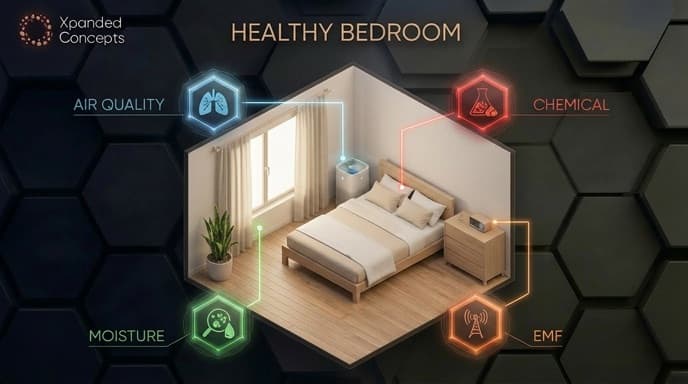
1. Time Spent in the Bedroom
The bedroom is the most significant space in the home simply because of how much time is spent there. On average, we spend around a third of our lives in this environment, making it one of the most consistent and repeated exposure points in the home. Even small environmental factors, whether related to air quality, materials, or electromagnetic exposure, can become meaningful over time due to this constant duration. Improving the bedroom environment is one of the most effective ways to influence overall exposure, simply because of how frequently and consistently it is experienced.
2. The purpose of sleep

The primary purpose of the bedroom is rest and recovery. Sleep is when the body shifts into repair mode - supporting processes such as cellular repair, immune function, and neurological reset. For this to happen effectively, the environment needs to support that process rather than compete with it. Factors like clean air, low chemical load, minimal disturbance, and a stable environment all contribute to better quality sleep and more effective recovery.

Bedroom Building Design
From a building design perspective, the eastern façade is generally the preferred placement for a bedroom. This orientation allows the room to receive gentle morning sunlight, which helps align with the body's natural sleep-wake cycle while also providing early warmth to the space. That morning warmth plays a practical role as well - helping to dry out any condensation that may have formed overnight from breathing, reducing the risk of moisture build-up and mould over time. By contrast, the room avoids the harsher afternoon heat associated with western aspects, which can lead to overheating and reduced sleep quality. An east-facing bedroom supports both comfort and performance, making it a strong choice when designing a healthier home.

The Moisture Source
Moisture in the bedroom is often driven by one of the most overlooked sources, the occupants themselves. During sleep, each person releases a substantial amount of water vapour through breathing. There are multiple factors but it's typically in the range of 400ml to 1.5 litres over the course of a night per person. With two people in a room, that moisture load can double, placing a significant demand on the space to manage it effectively.
Read moreShow less
The moisture exhaled during sleep enters the room air as water vapour, an invisible gas. The amount of water vapour present in the air at any given time is what we describe as humidity.
The critical thing to understand is that warm air can hold significantly more water vapour than cold air.
When building materials such as external walls and ceilings are cooled by outside temperatures, the air immediately next to those surfaces becomes much cooler. As it cools, its ability to hold moisture drops, and the water vapour in that air converts into liquid water on the surface. This is condensation.
In a bedroom, condensation doesn't always appear as visible dripping water. It often forms as a thin, invisible film of moisture on: External walls, particularly poorly insulated ones, Windows and window reveals, Corners where air circulation is poor, Surfaces hidden behind furniture pushed against outside walls.
The Other Piece of the Puzzle - Food Source
Moisture alone is not enough for mould to grow. It also needs a food source. Mould won't grow on non-porous surfaces like glass or metal, what you're actually seeing on a window is mould feeding on the thin layer of dust and organic matter that has settled on the surface. The building material itself isn't the food; the dirt is.
Read moreShow less
Mould spores are always present in the air around us. The problem begins when spores land on a surface that offers two things together: moisture and a food source. Porous building materials like plaster, timber, carpet and paper-faced plasterboard are particularly vulnerable because they trap organic matter and absorb moisture. When those conditions persist, spores don't just survive - they amplify.
BEST PRACTICES FOR MOULD MANAGEMENT IN THE BEDROOM
Monitor humidity
A simple, inexpensive hygrometer lets you track bedroom humidity. Aim to keep relative humidity below 60% - above 70% consistently is a risk zone for mould growth.
Use a dehumidifier
In bedrooms prone to high humidity, a dehumidifier actively removes moisture from the air and can make a significant difference overnight when moisture levels from breathing peak. Empty and clean the water reservoir regularly to prevent it becoming a mould source itself.
Keep air conditioning units clean
AC units circulate air across internal coils that collect dust, moisture and organic matter - ideal conditions for mould. Filters and coils should be cleaned regularly, and units should be serviced at least annually. A dirty AC unit can actively spread mould spores through the room.
Keep furniture away from external walls
Allow a small gap between furniture and external walls so air can circulate freely. Pushed-up furniture creates stagnant, humid pockets where condensation and mould thrive unseen.
Clean surfaces on a schedule
Dust is a food source. Regular wiping down of walls, window reveals, skirting boards and the tops of furniture removes the organic matter mould feeds on. Pay particular attention to corners and areas that are easy to overlook.
Address condensation promptly
Wipe down windows and cold surfaces where condensation appears. Even a recurring invisible film of moisture is enough to sustain mould growth over time.
Improve insulation where possible
Cold surfaces are the root cause of condensation. Improving insulation - through better glazing or internal wall insulation - raises surface temperatures and reduces the conditions where dew point is reached.

Mould Testing & Analysis
Want To Reduce The Mould Spores You Breathe Every Night?

Bedroom Air Quality
Most people think of air pollution as an outdoor problem. In reality, the air inside your bedroom, the space where you spend roughly a third of your life can contain a far more complex mix of contaminants than the air outside. For anyone interested in building biology and healthy homes, bedroom air quality is one of the highest-impact areas to address.
WHAT'S ACTUALLY IN YOUR BEDROOM AIR?
Indoor air is rarely just air. Depending on the home, its age, furnishings and occupants, bedroom air can contain:
Biological contaminants
Mould spores, dust mite allergens, pet dander and bacteria. These are particularly concentrated in soft furnishings - mattresses, pillows, carpet and curtains, and in any area where moisture has been an issue.
Volatile Organic Compounds (VOCs)
VOCs are gases emitted from materials and products. In a bedroom this includes furniture, mattresses, carpet, paints, adhesives and personal care products. New furnishings and recently renovated rooms tend to have the highest VOC levels, a process known as off-gassing.
Carbon Dioxide (CO₂)
Every breath you exhale raises the CO₂ level in the room. In a closed bedroom overnight, CO₂ can build to levels that significantly affect sleep quality and cognitive function the following day. Elevated CO₂ is one of the most overlooked factors in poor sleep.
Particulate Matter
Fine particles from outdoor pollution, candles, incense, cooking fumes that migrate through the home, and general dust all contribute to the particulate load in bedroom air.
WHY BEDROOM AIR QUALITY MATTERS FOR HEALTH
We are most vulnerable during sleep. Our breathing rate drops, our body is in repair mode, and we have no conscious awareness of what we are inhaling for seven to nine hours straight. The cumulative effect of poor bedroom air quality is significant:
- Elevated CO₂ overnight is linked to reduced sleep quality, morning fatigue and impaired concentration
- Mould spores and dust mite allergens are among the most common triggers for asthma, rhinitis and disrupted sleep
Read moreShow less
- Long-term VOC exposure, particularly formaldehyde, is associated with respiratory irritation and in higher concentrations, more serious health outcomes
- Particulate matter, even at low concentrations, places a chronic burden on the respiratory and cardiovascular system
Children, the elderly, and those with existing respiratory conditions are most vulnerable, but the effects on otherwise healthy adults are well documented and increasingly hard to ignore.
NATURAL VENTILATION - SINGLE-SIDED VS CROSS VENTILATION
How air moves through a bedroom determines how effectively these contaminants are diluted and removed.
Read moreShow less
Single-sided ventilation is what most bedrooms rely on, one window or opening on one side of the room. Air exchange happens, but it is driven only by wind pressure and temperature difference. It is limited in depth, meaning air in the centre and far side of the room may barely turn over. On still nights it can be almost ineffective.
Cross ventilation occurs when openings exist on opposite or adjacent sides of a room, a window and a door, or windows on two walls. Air flows through the space rather than just in and out of the same opening. This dramatically increases the volume of air exchanged, reduces CO₂ buildup, carries moisture and contaminants out of the room far more effectively, and does so passively without mechanical assistance.
From a building biology perspective, cross ventilation is the gold standard for bedroom air quality. Where it isn't possible through layout, mechanical ventilation becomes an important consideration.
Mechanical Ventilation
WHOLE-HOUSE FAN/VENTILATION
A whole-house fan is a powerful central exhaust fan, typically installed in a ceiling or stairwell that exhausts a large volume of air from the home, drawing fresh air in through whichever windows and doors are open. By controlling which openings are open you can direct airflow through the house, creating a genuine whole-home breeze. It is a low-cost, low-tech and highly effective solution for whole home ventilation & comfort.
HEAT RECOVERY VENTILATION (HRV)
An HRV continuously replaces stale indoor air with fresh outdoor air, passing both streams through a heat exchanger that transfers warmth from the outgoing air to the incoming air. The result is continuous fresh air without the heat loss of simply opening a window. HRVs are best suited to cold climates where heating costs are significant and windows are kept closed for extended periods.
ENERGY RECOVERY VENTILATION (ERV)
An ERV works on the same principle as an HRV but also transfers moisture between the air streams, moderating humidity in both directions, reducing incoming humidity in wet seasons and retaining indoor humidity in dry, cold conditions. This makes it a more balanced year-round performer across a wider range of climates.
Not All Air Purifiers Are Equal - See Why Xpanded Concepts Chooses Innova Air
STRATEGIES TO IMPROVE BEDROOM AIR QUALITY
Ventilate daily and deliberately
Open windows every morning to flush overnight CO₂ and moisture from the room. Where cross ventilation is possible, even ten minutes of through-flow makes a measurable difference.
Choose low-VOC materials
When replacing flooring, painting, or purchasing new furniture, choose low-VOC certified products. Allow new items to off-gas in a well-ventilated space before bringing them into the bedroom.
Reduce soft furnishing load
Carpet, heavy curtains and an excess of cushions and textiles harbour dust mite allergens and trap particulates. Hard floors with washable rugs are preferable in bedrooms where air quality is a concern.
Wash bedding regularly
Bedding is the single greatest concentration point for dust mite allergens in most bedrooms. Washing at 60°C kills dust mites effectively. Mattress and pillow protectors add another layer of defence.
Use a HEPA air purifier
As covered earlier, a quality HEPA air purifier reduces airborne spores, allergens and particulates in the room - particularly valuable overnight when the room is closed.
Monitor CO₂ and humidity
A combined CO₂ and humidity monitor gives you real data on what is actually happening in your bedroom air. CO₂ levels above 1000ppm are a signal that ventilation is insufficient. Many people are surprised at what these devices reveal.
Address the building fabric
Draughts, gaps around windows and poorly sealed ceiling penetrations allow uncontrolled air movement that can bring in outdoor pollutants, moisture and in some cases radon. A well-considered approach to airtightness - paired with controlled ventilation - is far preferable to a leaky building.
Have AC units and ducted systems serviced
Any mechanical system that moves air through the bedroom needs to be clean. Dust and biological growth inside ducts and on coils is distributed directly into the breathing zone.

EMF in the Bedroom
Electromagnetic fields (EMF) are an invisible but ever-present feature of the modern built environment. Escaping EMF during the day is, in many cases, simply not achievable. We live and work in environments saturated with wireless technology and electrical infrastructure. The bedroom at night is a different story entirely.
Read moreShow less
No one uses their phone while they sleep. No one needs Wi-Fi at 2am. The bedroom is already a place of rest, recovery and restoration. And from a building biology perspective, it is also the single greatest opportunity for EMF mitigation. Giving your body a break from electromagnetic exposure during sleep is not a sacrifice. It costs nothing in lifestyle or convenience. It is simply allowing your body the conditions it needs to do what it does naturally overnight - without unnecessary interference.
AC MAGNETIC FIELDS
AC magnetic fields are generated wherever alternating current flows, power lines, wiring in walls, and electrical appliances. AC Magnetic fields pass through almost everything- concrete, steel, shielding products & the human body.
The key concern in a bedroom is what is directly behind the wall at the head of the bed. A switchboard, meter box, ducted AC unit, refrigerator or other high-draw appliance on the other side of that wall can produce a magnetic field that extends well into the sleeping space. The thing to understand about AC Magnetic fields is distance is our only defence, & they drop off quickly.
The simple rule is don't sleep on the back of anything that draws significant current. Repositioning a bed is often all it takes to move out of an elevated field.

RADIOFREQUENCY (RF)
Radiofrequency radiation is emitted by the wireless devices that now saturate most homes - Wi-Fi routers, smart meters, cordless phones, baby monitors and mobile phones. Unlike AC magnetic fields which come from the building itself, RF exposure in the bedroom is largely driven by the choices we make about the devices we bring into the space and leave running overnight. RF fields diminish rapidly with distance, which means proximity matters enormously. A phone charging on a bedside table produces a very different exposure to one left in another room.
Read moreShow less
The science on EMF and human health continues to evolve and there is genuine ongoing debate. A building biology approach does not require certainty of harm to act - it applies the precautionary principle. If plausible biological concern and simple steps can reduce exposure, those steps are worth taking. There are now over a hundred peer reviewed studies indicating potential harm.
The bedroom is actually the easiest place to apply this thinking, because you are asleep. You are not using your phone, you are not on Wi-Fi, you are not streaming or scrolling. Reducing EMF exposure overnight costs you nothing in lifestyle or convenience. You are simply giving your body the conditions it needs to do what it does naturally during sleep, rest, repair and recharge, without unnecessary interference.
Practical steps are straightforward:
- Turn Wi-Fi off at the router overnight - A simple power timer can do this, set & forget.
- Leave your phone outside the bedroom.
Read moreShow less
- Do not leave smart watches, or any other wireless device by your bed
- Test your sleeping area - These fields are invisible and you may be affected by other sources. Testing is the only way to know and reduce exposure.
Small changes. No lifestyle cost. A meaningful reduction in your overnight exposure.

Chemicals In The Bedroom
The bedroom is rarely thought of as a chemical environment. There are no cleaning products on the shelf, no solvents under the sink. Yet from a building biology perspective, the bedroom can be one of the most chemically complex spaces in the home, precisely because the sources are hidden, subtle and largely odourless once a room has been lived in for a while.
VOLATILE ORGANIC COMPOUNDS (VOCS)
Volatile Organic Compounds are chemicals that off-gas from materials and products at room temperature, meaning they silently enter the air you breathe without any visible sign. In a bedroom, the sources are numerous:
Building materials and finishes
- Plywood, MDF and particleboard used in built-in wardrobes, shelving and furniture frames - common sources of formaldehyde, a known carcinogen
- Paints, varnishes and timber stains on walls, skirting boards and flooring
Read moreShow less
- Carpet adhesives and synthetic carpet fibres
- Vinyl and laminate flooring
- Ceiling and wall insulation materials
- Furniture and soft furnishings
- Mattresses - conventional foam mattresses, particularly those made with polyurethane foam, off-gas a cocktail of VOCs including benzene and toluene. New mattresses are the worst offenders
- Pillows - synthetic fill materials off-gas similarly to foam mattresses
- Upholstered bed heads and bedroom furniture
- Curtains and blinds, particularly those with stain-resistant or wrinkle-resistant treatments
- Personal care and laundry products
- Fragranced fabric softeners and dryer sheets leave VOC residue in bedding and clothing
- Air fresheners and scented candles - significant VOC sources that are often used to make a bedroom smell clean while adding to the chemical load
- Dry-cleaned clothing and manchester brought into the bedroom
The concern with VOCs in a bedroom is cumulative exposure over many hours in a closed, poorly ventilated space. Individually, many of these sources sit below levels considered acutely harmful. Together, overnight, in a sealed room - the picture is less straightforward.
FLAME RETARDANTS
Flame retardants are a chemical category that deserves particular attention in the bedroom - and especially in children's rooms.
Read moreShow less
Synthetic mattresses, mattress protectors and children's pyjamas are commonly treated with flame retardant chemicals, in many cases required by product safety regulations. The most concerning of these are organophosphate flame retardants and historically, brominated compounds - chemicals associated with endocrine disruption, meaning they can interfere with the body's hormonal system.
Children are more vulnerable than adults for two reasons, their developing endocrine and nervous systems are more sensitive to chemical interference, and they spend more hours in bed relative to their body weight, meaning proportionally higher exposure. A child sleeping in treated pyjamas on a treated mattress for ten to twelve hours represents a significant cumulative contact with these chemicals.
Natural alternatives: untreated organic cotton pyjamas and wool or organic latex mattresses are worth considering, particularly for young children.
OTHER CHEMICAL SOURCES WORTH CONSIDERING
- Electromagnetic and off-gassing from electronicsTelevisions, gaming consoles and chargers left on or in standby in the bedroom generate heat, which accelerates off-gassing from their plastic casings and internal components.
- Pesticides and garden chemicalsTracked in on footwear or hands and settling into carpet and bedding, pesticide residues can accumulate in bedroom dust over time.
Read moreShow less
- Dry-cleaned itemsPerchloroethylene (PERC), the solvent widely used in dry cleaning, is a probable human carcinogen. Dry-cleaned clothing or manchester brought directly into the bedroom and stored in a closed wardrobe can off-gas into the sleeping space.
- MothballsStill used in many wardrobes, mothballs contain naphthalene or paradichlorobenzene - both volatile and both associated with respiratory irritation and longer-term health concerns with repeated exposure.
REDUCING CHEMICALS IN THE BEDROOM
The first step is simply awareness. Most people have never considered that their bedroom carries a chemical load - once you understand the sources, the path forward becomes clear.
Read moreShow less
The strategy is straightforward. Reduce as many sources as possible by making conscious choices around materials and products, natural fibre bedding, low-VOC paints and finishes, solid timber over MDF and particleboard, and fragrance-free laundry products. You don't need to replace everything at once; prioritise the items closest to your breathing zone and work outward from there.
Ventilation is the next layer. Fresh air dilutes and displaces VOCs that have accumulated overnight. Opening the bedroom up daily - even for fifteen to twenty minutes, makes a measurable difference to the chemical load in the room air.
Finally, air purification. A HEPA filter addresses biological contaminants like dust and spores, but for chemicals you need a unit that also contains activated carbon. Carbon filtration adsorbs VOCs and other gaseous pollutants from the air, something a HEPA filter alone cannot do. For a bedroom with a meaningful chemical load, a combined HEPA and activated carbon air purifier running overnight is one of the most effective tools available.
Dramatically Reduce VOC With Me

LIGHT IN THE BEDROOM
Light is one of the most powerful biological signals the human body receives. It governs our circadian rhythm, the internal 24-hour clock that regulates sleep, wakefulness, hormone production, metabolism and immune function. In the modern bedroom, light is also one of the most routinely mismanaged environmental factors, with consequences that are well documented and significantly under appreciated.
THE LIGHT SPECTRUM AND CIRCADIAN RHYTHM
Natural light spans a broad spectrum from warm reds and oranges at sunrise and sunset through to cool blues at midday. This spectrum is not arbitrary, our biology evolved to use it as a timing signal. Warm light signals the body to wind down and prepare for sleep. Cool blue light signals alertness and daytime activity.
Read moreShow less
The problem is that the artificial lighting environments we now inhabit at night bear little resemblance to the light signals our biology expects. LED screens, overhead lighting and device displays flood the evening environment with blue-spectrum light at precisely the time the body is expecting the warm, dim light of a fire or sunset.
The mechanism is well understood. Blue light suppresses the production of melatonin, the hormone that initiates sleep, via specialised photoreceptors in the eye called intrinsically photosensitive retinal ganglion cells. Even relatively brief exposure to blue light in the evening can delay melatonin onset, push back sleep timing, reduce total sleep duration and compromise sleep quality. In children and adolescents, whose eyes transmit more blue light to the retina than adults, the effect is amplified.
THE PROBLEM WITH LED FLICKER
A less discussed but significant issue with modern LED lighting is flicker. Unlike incandescent bulbs which produce continuous light, most LED lights operate by rapidly switching on and off, often at frequencies between 50 and 120 times per second. At low flicker rates this can be perceptible as a visual flutter. At higher rates it becomes invisible to the conscious eye but is still detected by the nervous system.
Read moreShow less
Research links LED flicker to eyestrain, headaches, fatigue and in sensitive individuals, neurological symptoms. From a building biology perspective, spending seven to nine hours in a room lit by flickering light, even subconsciously detected, represents an unnecessary biological stressor. Higher quality LEDs and those rated with a high Flicker Index rating are available, but they are rarely the default choice in standard residential lighting.
THE CASE FOR COMPLETE DARKNESS
The goal in a bedroom optimised for sleep is not dim light - it is complete darkness. This is more important than most people realise.
Read moreShow less
The skin contains photoreceptors. Research has demonstrated that the body can detect light through the skin even with the eyes closed, meaning that light entering a bedroom affects your physiology regardless of whether you are aware of it. A streetlight through thin curtains, a standby light on a television, a charging indicator on a phone, none of these are trivial in a room designed for genuine biological recovery.
The body produces the majority of its melatonin and conducts much of its cellular repair work in darkness. Any light signal during this window has the potential to interrupt or attenuate that process. A truly dark bedroom is not a preference, from a building biology perspective it is a biological requirement for optimal sleep.
MITIGATION STRATEGIES
In the hours before bed
- Shift to warm, low-intensity lighting in the evening - amber and red spectrum light has minimal impact on melatonin production
- Use blue light filter settings on devices or wear blue-light blocking glasses in the two hours before sleep
- Avoid bright overhead lighting and favour lamps positioned below eye level
In the bedroom
- Install blockout curtains or blinds that eliminate external light sources completely - streetlights, car headlights and early morning sun all disrupt sleep architecture
- Remove or cover all standby lights, indicator LEDs and charging devices
Read moreShow less
- Choose warm-spectrum, low-flicker LED globes for any bedroom lighting - look for globes marketed as 2700K or lower and check flicker specifications where possible
- Use candlelight or salt lamps as evening wind-down lighting - both produce warm, flicker-free light at the red end of the spectrum with no meaningful blue light content
At sleep
- If complete darkness is not achievable through curtains alone, a quality sleep mask is a simple and effective solution
- Remove or relocate devices that emit any light whatsoever from the sleeping space